
Understanding the Key Differences Between SEO and SEM Strategies
- Icomply group

- Oct 27, 2025
- 5 min read
In today's digital world, businesses strive to improve their online visibility and attract customers. Two powerful strategies for achieving this are Search Engine Optimization (SEO) and Search Engine Marketing (SEM). Although both aim to increase a website's visibility in search engine results, they utilize different methods and tactics. Knowing the critical differences between SEO and SEM is essential for businesses looking to optimize their online presence effectively.

What is SEO?
Search Engine Optimization (SEO) is the practice of adjusting a website to boost its organic visibility in search engine results. This involves techniques aimed at increasing both the quality and quantity of traffic to a website through search engines. SEO covers various aspects, including keyword research, content creation, link building, and technical adjustments.
SEO is a long-term strategy that requires ongoing effort and patience. For instance, a well-optimized website can move from the second page of Google results to the first, significantly increasing its organic traffic. According to a study by SEO expert Ahrefs, the number one ranked site on Google gets about 31.7% of all clicks. This visibility leads to enhanced brand credibility and trust among potential customers.
What is SEM?
Search Engine Marketing (SEM) includes a broader range of marketing tactics designed to increase a website's visibility through paid advertising. SEM encompasses various forms of online advertising, such as paid search ads and display ads, that appear on search engine results pages (SERPs).
Unlike SEO, which is focused on organic traffic, SEM centers on driving traffic through paid methods. Advertisers bid on keywords to have their ads shown when users search for those terms. A report from WordStream indicates that the average click-through rate (CTR) for a paid search ad is 3.17%, making SEM a popular choice for businesses aiming for quick traffic and leads.
Key Differences Between SEO and SEM
1. Cost Structure
One of the primary differences between SEO and SEM is their cost model.
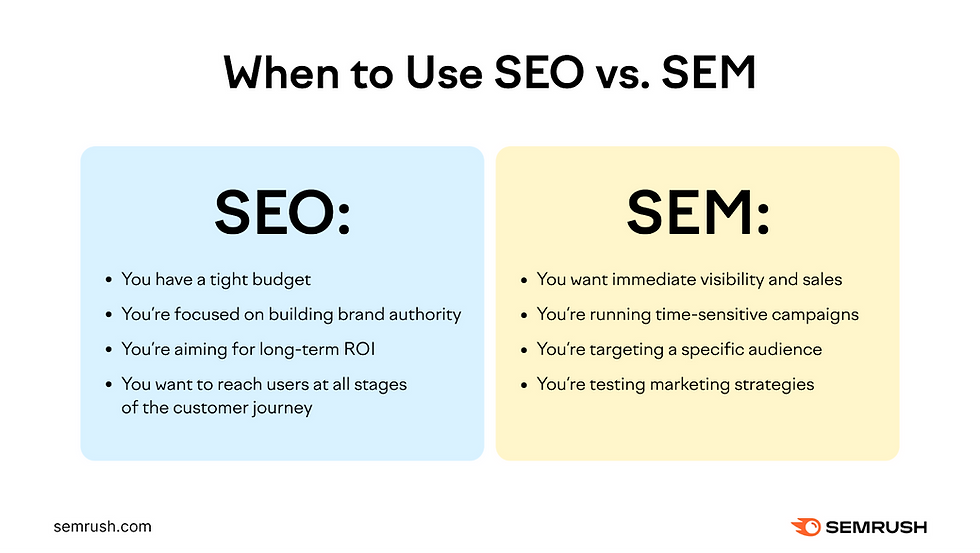
SEO is generally seen as a cost-effective long-term strategy. Initial costs may involve hiring SEO professionals or investing in tools, but ongoing costs are low. Once a website gains high rankings, it can keep attracting organic traffic without incurring additional expenses.
SEM operates on a pay-per-click (PPC) model, where advertisers pay each time a user clicks on their ad. In competitive industries, costs can escalate quickly; for example, bidding on terms like "personal injury lawyer" can go as high as $200 per click.
2. Timeframe for Results
The timeframe for seeing results varies significantly between SEO and SEM.
SEO is a long-term strategy requiring time and consistent efforts. It can take several months to achieve noticeable improvements in rankings and traffic. However, once established, a strong SEO position can maintain visibility with less ongoing input.
SEM, in contrast, can yield immediate results. Once an ad campaign is launched, ads can start appearing almost instantly in search results, driving traffic to the website. This immediacy makes SEM appealing for businesses looking to promote products or services during limited-time offers.
3. Traffic Quality
The quality of traffic generated through SEO and SEM also differs.
SEO typically attracts users actively searching for specific information, resulting in higher-quality traffic. Organic search results are often perceived as more trustworthy, leading to approximately 14.6% conversion rates for SEO, according to a study by Search Engine Land.
SEM, while effective at driving traffic, may attract users who are less engaged. Ads can be clicked out of curiosity rather than genuine interest, resulting in lower conversion rates—often around 2% to 5%.
4. Long-term vs. Short-term Strategy
SEO is fundamentally a long-term strategy designed to build sustainable online visibility.
By consistently optimizing content and improving user experience, businesses can establish authority over time. This gradual investment can yield steady, long-lasting organic traffic.
In contrast, SEM is often seen as a short-term strategy. While it can generate immediate results, once the advertising budget is depleted, visibility vanishes. Businesses must continually invest in SEM to retain their presence.
5. Skill Set Required
The skill sets required for SEO and SEM differ significantly.
SEO demands a strong understanding of search engine algorithms, keyword research, content strategies, and technical optimization. SEO professionals must stay informed about industry changes and best practices.
SEM, while also needing expertise, often relies more on advertising strategies, bid management, and campaign analysis. SEM professionals focus on optimizing campaigns for maximum return on investment (ROI), using tools such as Google Ads and analytics.
Integrating SEO and SEM
While SEO and SEM are distinct strategies, they can effectively complement each other.
Businesses can leverage SEO to create a solid organic foundation while using SEM to drive immediate traffic. For instance, companies can run SEM campaigns to test high-performing keywords, which can then be integrated into their SEO strategy.
Additionally, insights gleaned from SEM can enhance SEO efforts. By assessing user behavior during SEM campaigns, businesses can optimize their content with real-time data. Combining both approaches allows for a more comprehensive digital marketing strategy that maximizes visibility and results.
Best Practices for SEO and SEM
SEO Best Practices
Keyword Research: Carry out extensive keyword research to discover relevant terms that potential customers are searching for.
Quality Content: Focus on creating informative and engaging content that fulfills user intent and provides genuine value.
On-Page Optimization: Make sure title tags, meta descriptions, headers, and images are optimized for search engines.
Technical SEO: Keep the website technically sound with fast loading times and mobile-friendly design.
Link Building: Develop quality backlinks from credible sources to enhance trustworthiness and authority.
SEM Best Practices
Targeted Keywords: Select relevant keywords that connect with your audience and align with business goals.
Compelling Ad Copy: Write eye-catching ad copy that motivates clicks and engagement.
Landing Page Optimization: Ensure landing pages are tailored for conversions, featuring clear calls to action.
Regular Monitoring: Continuously track campaign performance to find areas for improvement.
Budget Management: Establish a defined budget and adjust bids according to performance to enhance ROI.
Final Thoughts
Grasping the key differences between SEO and SEM is vital for businesses committed to enhancing their online presence. SEO focuses on organic traffic and built-in long-term benefits, while SEM offers quick visibility through paid avenues.
By combining both strategies, businesses can create a well-rounded approach that bolsters their online visibility and drives sustainable growth. Whether you choose the long-term rewards of SEO or the swift results of SEM, balancing both strategies is crucial for navigating today's competitive digital landscape.
Leveraging the strengths of SEO and SEM will enable businesses to thrive in the complexities of the online world and accomplish their marketing ambitions.


Comments